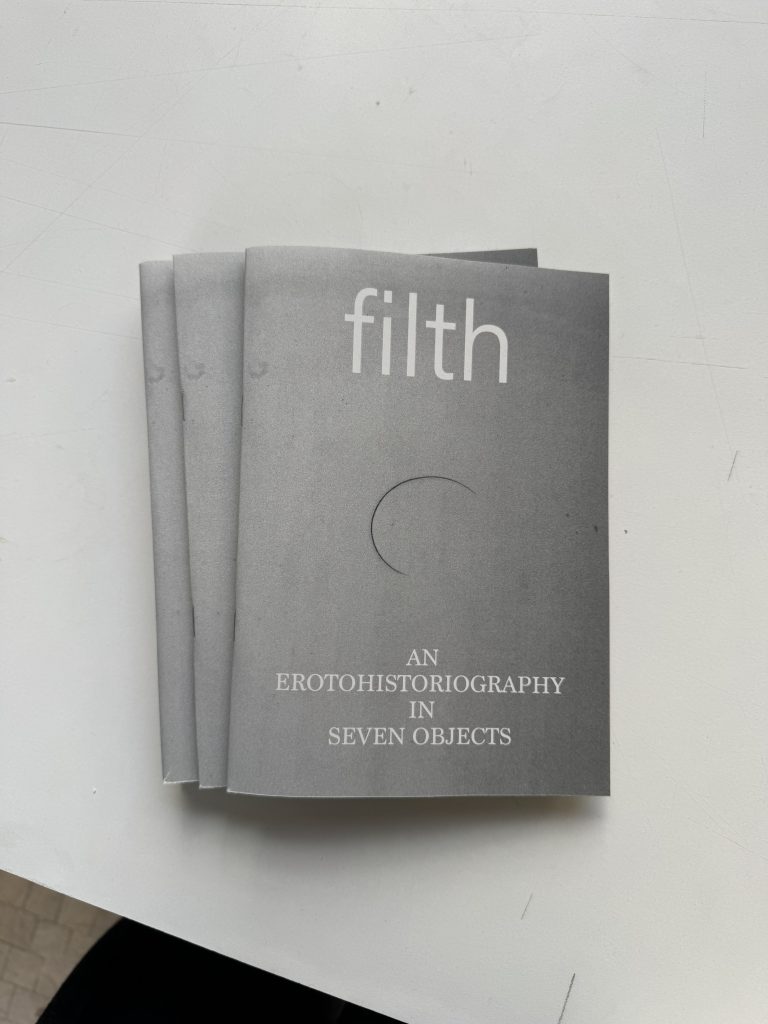
filth, a publication:
Foreword:
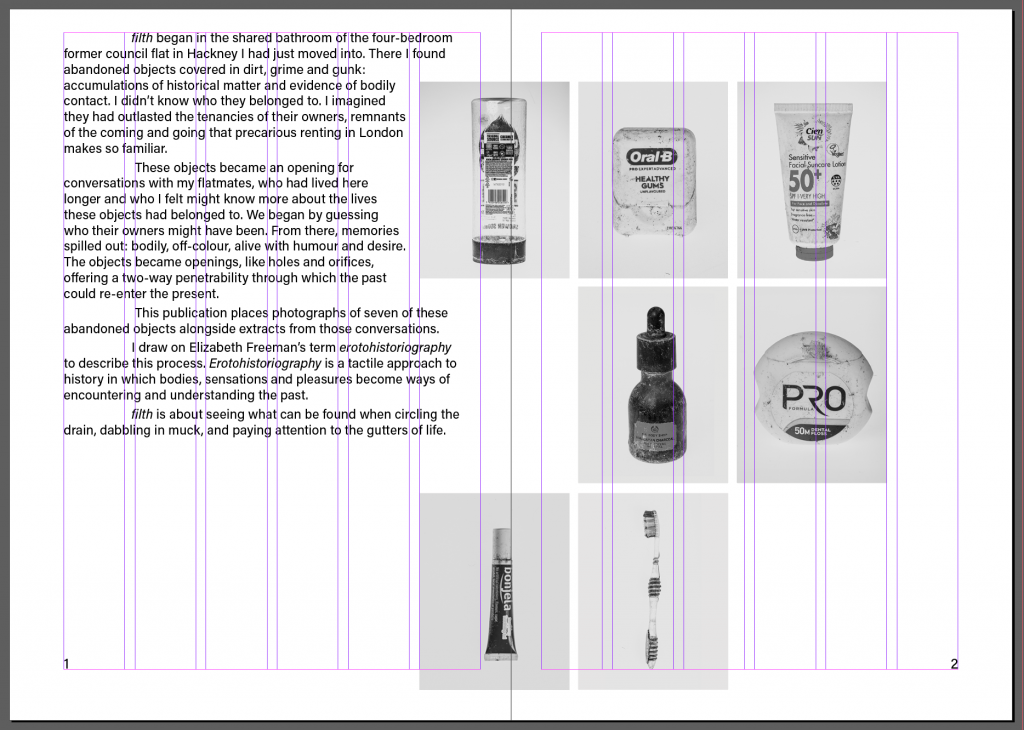
filth began in the shared bathroom of the four-bedroom former council flat in Hackney I had just moved into. There I found abandoned objects covered in dirt, grime and gunk: accumulations of historical matter and evidence of bodily contact. I didn’t know who they belonged to. I imagined they had outlasted the tenancies of their owners, remnants of the coming and going that precarious renting in London makes so familiar.
These objects became an opening for conversations with my flatmates, who had lived here longer and who I felt might know more about the lives these objects had belonged to. We began by guessing who their owners might have been. From there, memories spilled out: bodily, off-colour, alive with humour and desire. The objects became openings, like holes and orifices, offering a two-way penetrability through which the past could re-enter the present.
This publication places photographs of seven of these abandoned objects alongside extracts from those conversations.
I draw on Elizabeth Freeman’s term erotohistoriography to describe this process. Erotohistoriography is a tactile approach to history in which bodies, sensations and pleasures become ways of encountering and understanding the past.
filth is about seeing what can be found when circling the drain, dabbling in muck, and paying attention to the gutters of life.
As you might have noticed, one of the decisions I made was to call the publication filth, entirely in lowercase. The conversations included in it are also deliberately set in lowercase. Part of this is about tone. The stories were told to me conversationally, through informal exchanges with my flatmates. They are funny, intimate, sometimes erotic, and often quite tender. I wanted their translation onto the printed page to retain that free-flowing informality. I am also interested in history with a lowercase h, as opposed to History with a capital H: an institution or discipline with its own conventions and criteria for deciding what constitutes legitimate knowledge. I’m interested in these smaller, everyday, informal histories, relayed orally —particularly those that might seem too inconsequential or filthy to document.
Photography and interviewing operated as two parallel processes of investigation.
Through macro photography, I was able to look closely at the objects, bringing out details of dirt, residue and bodily contact that weren’t visible to the naked eye. Through editing, I could further exaggerate or foreground these traces of time. The interviews also offered a closer way of looking. Starting with the objects, my flatmates began speculating about who might have owned them. This opened up memories, stories and experiences of people who had previously occupied the flat. I think a key takeaway here is that neither photography nor interviewing uncovers a pre-existing, stable truth. Both modes of investigation involved a degree of speculation and interpretation. These objects therefore became more than artefacts of the past: they offered openings for producing knowledge in the present.
Ultimately, this investigation has made me think about how objects—particularly those that have been abandoned, discarded or considered worthless—might be brimming with social meaning. They provide openings into histories of shared living, relationships, community, intimacy and desire.
Leave a Reply